
 I don't like work - no man does - but I like what is in the work - the chance to find yourself. Your own reality - for yourself, not for others - what no other man can ever know. They can only see the mere show, and never can tell what it really means. Joseph Conrad, Heart of Darkness, Kindle Location 535-37.
What does it mean to find yourself? Is is possible to do something and in the act of doing that particular task or job find yourself? In the same vein, is it possible to get so lost within a task or job that you lose track of who you even are? Does a job provide an opportunity for others to see who you are or does a job simply allow you to test yourself to see what's within you? I struggled nearly every single day I worked at the church. I was so frustrated, lost, confused, hurt, and often angry at my job there. I was bitter to my wife. I struggled to invest in my own kids. I felt parts of my own life ebbing away as if the days, weeks, months and years were being consumed by a beast I had no idea how to contain or control. Often times I wondered why I kept toiling at something that no matter how hard I tried never seemed to fit. Questions I asked never seemed to be answered. Those above me would always point out that I had issues that needed to be sorted out but that the job itself was fine. Those I encountered assumed the job was great for me and that it fit so well for my skills, personality, and experiences. I was lost amongst it all, not knowing what to do, who to turn to, or what the hell was wrong with me. Looking back I can see clearly now that I was searching for something that couldn't be found there. A job, in a myriad of ways, can never truly give identity or purpose. However, within a job one can experience the journey towards finding out who they are and what their reality is. The job in and of itself is not that critical. However, the job can either assist in the process of discovery or simply be a stumbling block towards recovery of oneself. Working for the church was never meant to be for me. Others could see the "mere show" and assume they knew what was best - but only I could tell what was going on. I was even accused of using the church to further myself as if somehow I wasn't providing enough return for the labor I put forth. Man that pissed me off. But in the end, who cares. What matters is that I ended up finally stumbling in a new direction of teaching & education. I have yet to find a job and reality in this economy doesn't speak too kindly to my prospects. But in the short time I have worked at a school I have found a vocation that has opened the floodgates of thoughts, feelings, and ideas welled up within me. Reality is at the end of the tunnel, and for a change, my job allows me to see it. I am finding myself on a daily basis now. Are there difficult parts to my job? Certainly. But it has provided me the opportunity to explore and experience life. I am finding a new me, and I really love it. The mere show others might see probably gives them an opinion or two on who I am. But now I don't care anymore. No one can tell, explain, or experience the depth of refreshment I have found in teaching. Reality is finally here and now I am not afraid of it.
Friday, April 15, 2011
My Own Reality
Wednesday, April 13, 2011
Spectral Illumination
 The yarns of seamen have a direct simplicity, the whole meaning of which lies within the shell of a cracked nut. But Marlow was not typical (if his propensity to spin yarns be excepted), and to him the meaning of an episode was not inside like a kernel but outside, enveloping the tale which brought it out only as a glow brings out a haze, in the likeness of one of these misty halos that sometimes are made visible by the spectral illumination of moonshine. Joseph Conrad, Heart of Darkness, Kindle Location 60-63.
The idea of a seamen & ability to tell yarns is humorous enough, but in the case of Marlow we see a complex story of complexity and depth that speaks much to the condition of the human soul as well as the period of European expansion in Africa. As Marlow recounts his tale, we see a story filled with descriptions that have meaning far beyond that which he simply states. The joy of reading Conrad's book is understanding the depth of what he is trying to communicate. The above quote really showcases the book as a whole. Meaning is more than that which is found when a nut is cracked open - rather that which is outside of the entire nut. In other words, the entire picture of situation, person or scenario must be understood, studied and appreciated in order for it to be grasped. It is far too easy to just to conclusions and assumptions based upon what we can see and immediately understand. Much like when we crack open a peanut shell expecting to find a peanut, we quickly formulate ideas about people or situations based upon what we find to logically fit. Those false assumptions end up tainting our viewpoints, restricting us from seeing real truth. How much do we miss out by failing to see that which is only lit by the "spectral illumination of the moonshine" as Conrad states through Marlow? The story always contains more depth then meets the eye. Our goal as people ought to be the examination and study of people, situations and scenarios that yield the greatest amount of understanding and appreciation. It is only then that we can truly hope to limit the damaging destruction of our own willful ignorance and bias.
Sunday, April 10, 2011
Terror
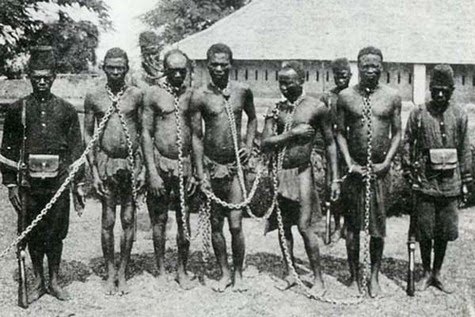 As the rubber terror spread throughout the rain forest, it branded people with memories that remained raw for the rest of their lives. A Catholic priest who recorded oral histories half a century later quotes a man, Tswambe, speaking of a particularly hated state official named Leon Fievez, who terrorized a district along the river three hundred miles north of Stanley Pool: All the blacks saw this man as the Devil of the Equator...From all the bodies killed in the field, you had to cut off the hands. He wanted to see the number of hands cut off by each soldier, who had to bring them in baskets...A village which refused to provide rubber would be completely swept clean. As a young man, I saw [Fievez's] soldier Molili, then guarding the village of Boyeka, take a big net, put ten arrested natives in it, attach big stones to the net, and make it tumble into the river...Rubber caused these torments; that's why we no longer want to hear its name spoken. Soldiers made young men kill or rape their own mothers and sisters. A Force Publique officer who passed through Fievez's post in 1894 quotes Fievez himself describing what he did when the surrounding villages failed to supply his troops with the fish and manioc he had demanded: "I made war against them. One example was enough: a hundred heads cut off, and there have been plenty of supplies at the station ever since. My goal is ultimately humanitarian. I killed a hundred people...but that allowed five hundred others to live."
Sick. Twisted. Morbid. Utter darkness. The absolute depraved condition of men is incredibly difficult to acknowledge and learn about. Just how far we as people are willing to go in our quest for wealth & power is beyond sickening.
Thursday, April 7, 2011
Message, Audience & Self-interest
 Morel knew exactly how to fit his message to his audience. He reminded British businessmen that Leopold's monopolistic system, copied by France, had shut them out of much Congo trade. To members of the clergy he talked of Christian responsibility and quoted the grim reports from missionaries. And for all Britons, and their representatives in Parliament, he evoked the widespread though unspoken belief that England had a particular responsibility to make decency prevail in the universe. Adam Hochschild, King Leopold's Ghost: A Story of Greed, Terror, and Heroism in Colonial Africa, (New York: Mariner Books, 1999), Kindle Location 3745-48.
Saturday, March 12, 2011
Fluidity Of Boundaries
 Les Demoiselles d'Avignon
 Adam Hochschild, King Leopold's Ghost: A Story of Greed, Terror, and Heroism in Colonial Africa, (New York: Mariner Books, 1999), Kindle Location 1313-26.
What stuck out to me was Hochschild's point of the fluidity of the boundaries between the different worlds for Africans at that time in history. I was struck at how amazing it must have been to not see such distinct lines between what we might call "reality" and that of the spiritual world (as well as that of humans and of animals!). Europeans were so compressed into realism that the potential to shed oneself of its shackles must have been so liberating to artists and free-thinkers of that time period. The question it begged to me was: How often do we fail to see the bigger picture because of the cultural restraints we place upon ourselves? We become so accustomed to seeing things and doing things based upon what we know, see and understand that we willingly stunt our creativity and possibility. As realism in art gave way to the liberating movement of cubism - we too have the potential to taste more liberating freedom if we allow ourselves to move beyond our own restrictions.
In particular, the spiritual world should be viewed in light of being intimately connected to that which we call reality. The amazing aspect of that is that a continent westerners shamelessly called "dark" was in reality a light to the concept of freedom of thought and expression. Instead of exploiting Africa - Westerners would have done the world a lot better favor by learning from Africa.
Sunday, March 6, 2011
Life Change By Reading
 I recently started a book on the brutal massacre of millions of Africans from the area known as the "Congo Free State" under the leadership of King Leopold the II from Belgium. It is something I sadly know little about. My hope is to not only learn more about it but also like all historical learning to apply its learning to my own personal life. In other words, I hope my life is changed by what I read.
Life change by reading. I was having a text conversation with an old friend the other day and he was teasing me about my constant reading of history books. I am guilty as charged as the majority of books I read are generally historical & non-fiction in make-up. Why? There are a few reasons. One, I love to learn about history. I think true history is fare more exciting and interesting than fiction. It actually happened! Two, I think there is much to be learned from history. What we fail to grasp, learn, and improve upon sets up tragic potential for as of yet untold future. And finally, I read history books because they give me the facts, stories, and colorful additions to my ability to teach students. History is so much more than numbers & names. It is the very foundation human civilization is built upon - both good & bad. My goal is to help students understand that and have fun while learning.
So that is why I read what I read. Of course, everyone is different and everyone has their own set of likes, ideas, and tastes. With that in mind - my challenge would be for everyone to simply read more. Find out what interests you and spurs you on to better thinking, more creativity, and passion and then read, read, read.
Saturday, February 26, 2011
Personal Connection
Religious social networking. According to the research, religious Americans are more apt to be good neighbors and civic-minded simply because of the social networks provided by their particular religious institution. In other words, a church can have good preaching, good music, and a dynamic building - but without relationships it will mean squat. Without providing a forum and opportunity for true networking (none of that Sunday bullshit of "How you doing" & "I'm doing fine") - people will not change because of church. As Putnam and Campbell say it, "devout people who sit alone in the pews are not much more neighborly than people who don't go to church at all. The real impact of religiosity on niceness or good neighborliness, it seems, comes through chatting with friends after service or joining a Bible study group, not from listening to the sermon or fervently believing in God." People MUST connect with people to make religious participation meaningful. A perfect call for community.
It is amazing to me to see a well researched and articulated book point out the obvious and yet for the church to still not get it. How is it that we see book after book written about the need for community and then even have researched data to back it up - and yet it can still feel so hollow and empty when we go to church? We see the show, we feel the entertainment, and we can tell time and money have been invested...and yet none of it matters or penetrates. Even when we remark on the "timeliness of such a great sermon" - it usually has exited our thoughts by the time we hear that 6 am alarm the next morning. In many ways, that after church lunch with our group of church friends is more critical to developing our lives than the service we just got out of.
So should we ditch church all together? I don't think that is the answer or even a logical step. The church service still has meaning and purpose. However, the reality is that what churches need to do more of is develop ways for people to move beyond attendance and into meaningful relationships. The primary source of all time, creativity, energy, money, and effort needs to be relationship development. Because at the end of the day - that will truly transform more lives than a service. People become better people as a result of truly doing life with other people. Don't tell me you have Bible studies, small groups, or midweek programming. Give me something every single time I come in contact with your church that shows me relationship. Then, and truly one then, will church showcase the intimacy, relationship, and love that Jesus Christ desires with us.
After all, in heaven I would expect Jesus to give me a hug, share a story, or simply laugh with me NOT show me His ability to shock & awe my senses.

 Posts
Posts

